If you're living in an Indian home, it's likely that your kitchen sink gets a lot of use—from cleaning heavy..
September 15, 2026
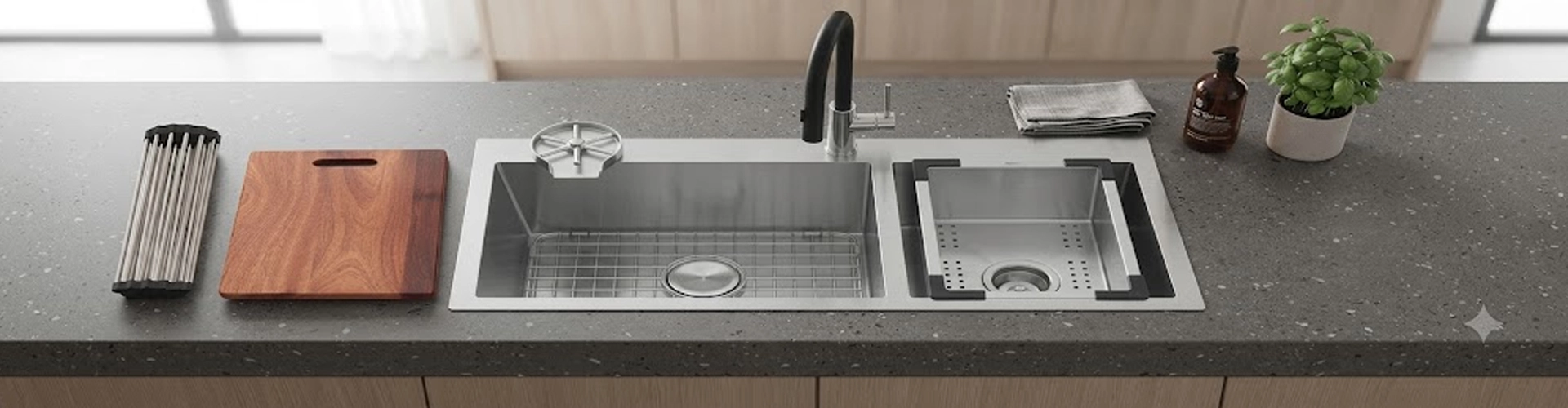
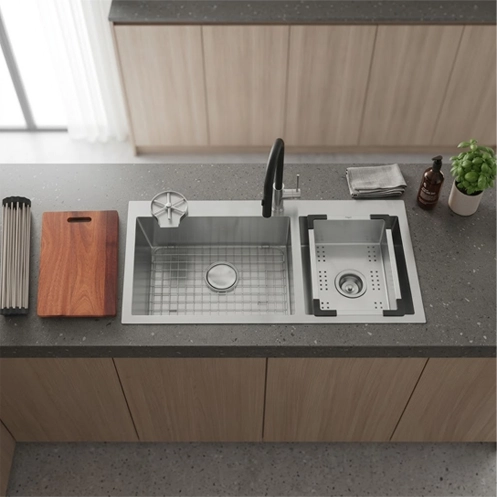
You’ve picked out a handmade sink, maybe even had it custom-fabricated to fit your kitchen exactly right — and now you’re staring at a wall of faucet options wondering if the wrong one is about to throw off everything you just got right. It’s a fair worry. A faucet isn’t just a fixture; it’s the thing your hand touches every single day, and next to a sink built by hand, a mismatched faucet can genuinely look out of place.
Here’s how to think through the pairing so your faucet complements the sink instead of competing with it.
A handmade sink has character. The seams, the hand-finished corners, the slightly more sculpted basin shape — these details set it apart from a mass-produced pressed sink straight out of a mold. Pair that with a faucet that feels generic or overly industrial, and the contrast can undercut the craftsmanship you paid for. On the flip side, the right faucet can actually highlight what makes a handmade sink special.
Handmade sinks are often built larger or deeper than standard pressed models, A short, stubby faucet can look undersized next to a deep basin, while an oversized restaurant-style pull-down can dominate a smaller handmade sink. Measure your basin depth and width before choosing a faucet height and reach — it matters more here than with a standard sink, simply because handmade dimensions vary more from piece to piece.
Bridge faucets, with their exposed connecting pipe between the hot and cold handles, echo the visible craftsmanship of a handmade sink. Both are built from distinct, deliberate parts rather than one molded unit, which is part of why the two tend to look like they belong together — especially in farmhouse or transitional kitchens.
If your handmade sink has a deep basin, a gooseneck faucet gives you the clearance to fill large pots without cramming your hands against the sides. The tall, curved silhouette also tends to complement the more organic, hand-formed lines of a custom basin better than a flat, angular faucet does.
For handmade sinks in a more utilitarian or professional-style kitchen, a pull-down faucet with an exposed spring coil can actually work in the sink’s favor — both share that “built, not molded” feel. This pairing tends to suit stainless steel handmade sinks with a brushed or matte finish rather than a mirror-polished one.
Steer clear of faucets with heavily ornate, traditional detailing (think elaborate scrollwork or aged brass finishes) unless your entire kitchen is leaning into a classic, vintage aesthetic. Against the clean lines of a stainless steel handmade sink, overly decorative faucets can read as mismatched rather than intentional.
Stainless steel handmade sinks generally pair best with chrome, brushed nickel, or stainless-finish faucets — tones close enough to the sink’s own finish that they read as one cohesive setup rather than two competing metals.
That said, mixed metals aren’t off-limits. A matte black or brushed gold faucet can work well against a handmade steel sink if the rest of the kitchen’s hardware (cabinet pulls, light fixtures) echoes that same accent tone. The key is intention — one contrasting metal used consistently, not an unplanned clash.
Choose a bridge faucet if your kitchen has a farmhouse or transitional style and you want the faucet to visually match the handmade sink’s craftsmanship.
Choose a gooseneck faucet if your handmade sink has real depth and you regularly wash large pots, baking sheets, or produce.
Choose an industrial pull-down if your kitchen leans modern-utilitarian and your sink has a matte or brushed finish rather than a polished one.
There’s no single “correct” faucet for a handmade sink — but there is a wrong approach, and that’s picking a faucet in isolation from the sink’s proportions and finish. Measure your basin, decide whether you want the faucet to blend in or stand out on purpose, and match the metal tone to the rest of your kitchen’s hardware. Get those three things right, and almost any well-made faucet will look like it was chosen for the sink, not just installed on top of it.
It depends on how the sink was fabricated. Some handmade sinks are built with pre-drilled holes to a standard spread, while custom pieces may need holes cut to match a specific faucet. Confirm hole placement with your fabricator or installer before ordering a faucet.
In most cases, yes — a handmade basin doesn’t require a specialty faucet, just one sized and finished appropriately for the sink’s proportions and metal tone.
Single-hole faucets tend to suit the cleaner lines of a handmade basin, especially in modern or transitional kitchens, while three-hole setups (with separate handles) fit more traditional or farmhouse designs.
At Jayna Sinks, we build handmade stainless steel sinks with the proportions and finish details that make faucet pairing straightforward rather than a guessing game. If you’re planning a kitchen around a custom sink and want guidance on sizing or hole configuration before you commit to a faucet, reach out — we’re happy to walk through it with you.

If you're living in an Indian home, it's likely that your kitchen sink gets a lot of use—from cleaning heavy..
September 15, 2026
Your kitchen sink is the one that doesn’t really come to your mind when you are planning the new concept and..
September 15, 2026
The kitchen being the primary space and the most used space in the home requires to be cleaned and maintaine..
September 15, 2026


